
Is a 15-minute home Pilates plan three or four days a week enough for a beginner?
Is 15 minutes of home Pilates three or four days a week actually enough to build core endurance, steadier hips, and easier posture when you are starting from scratch? Yes: for a beginner returning to movement, four 15-minute sessions deliver 60 minutes of slow, high-tension mat and standing work each week without the soreness or scheduling friction that causes most 45-minute studio plans to stall by week two.
What fits comfortably inside one 15-minute (6-move) session
Studio classes spend large blocks of time explaining setups, transitioning props, and changing camera angles. When your plan is already decided for today and every move is shown by a clear four-second loop, 15 minutes holds six unhurried movements with calm 20 to 30 second rests between sets:
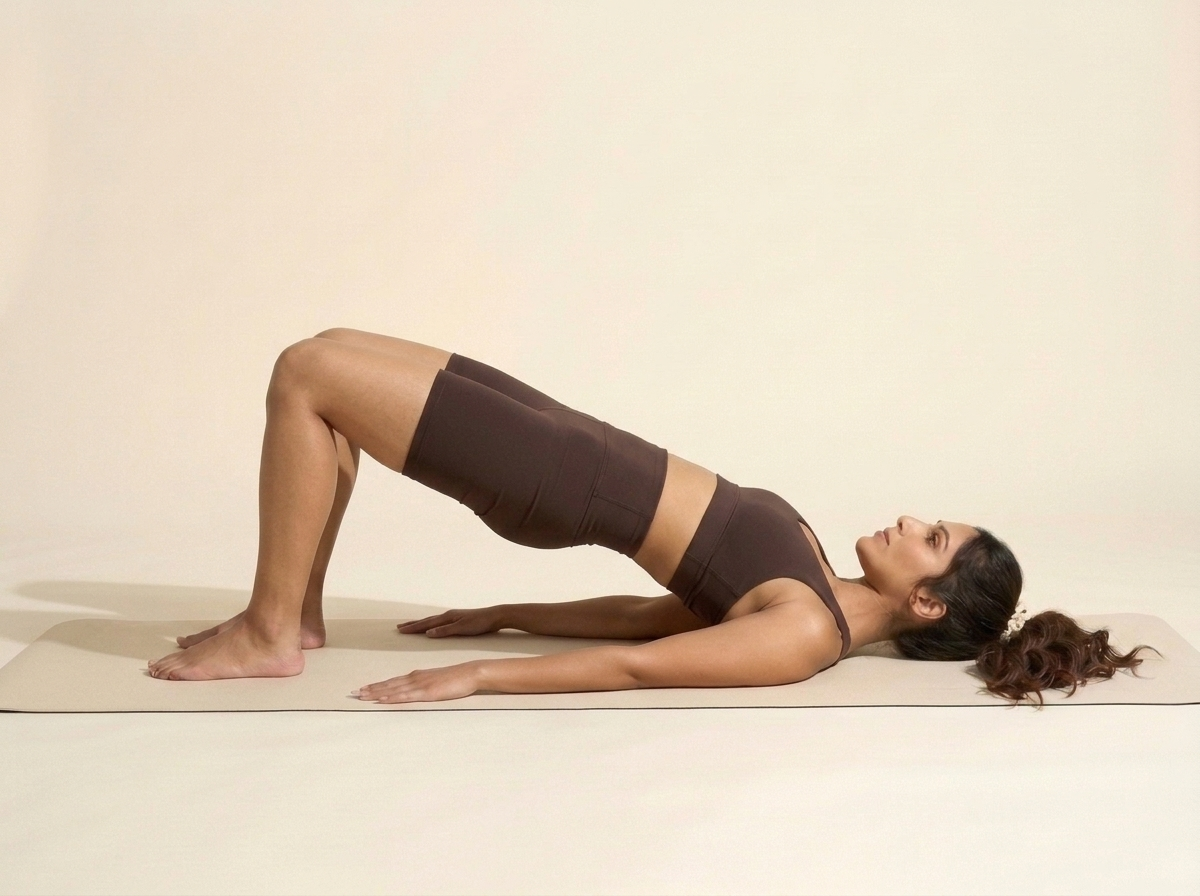
- Glute bridge (8 slow repetitions): Wakes up the posterior chain by pressing through your heels into a steady shoulder-to-knee diagonal line without loading your wrists.
- Forearm plank or knees-down forearm plank (20 to 30 second hold): Builds deep abdominal endurance while keeping your forearms flat on the mat and your neck long.
- Pilates supine march or slow dead bug (8 to 12 repetitions): Trains ribcage and pelvic control while one leg moves at a time on the exhale.
- Side-lying clamshell or outer-hip lift (12 repetitions): Strengthens the lateral hip stabilizers that support your knees when walking and climbing stairs.
- Seated spine twist or standing hip hinge (8 to 10 repetitions): Restores mid-back rotation or hamstring length without rounding your lower spine.
- Supine rib release (25 second hold): Settles your breathing and lets your shoulders rest heavy against the floor at the end of the session.
How progression works across four weeks without burnout
In a well-paced beginner plan, week one focuses on finding comfortable joint positions rather than chasing exhaustion. If 8 slow glute bridges already feel hard right now, starting at 5 controlled repetitions and adding roughly 8 percent volume per week across weeks two, three, and four builds strength steadily without leaving you stiff the next morning.
Shortening a session on a low-energy Tuesday matters just as much as completing a full session on Sunday. Stepping today down from 15 minutes (6 moves) to 10 minutes (4 moves) or even 5 minutes (3 moves) keeps the habit unbroken, while scheduled rest days give connective tissue time to adapt and deserve credit as kept days on your weekly schedule.
Cost and features check: SeeMeFit builds a personalized four-week 10 to 20 minute home Pilates and bodyweight plan (adjustable between 5 and 30 minutes, with rest days counted toward your streak, free streak repair, unlimited move swaps, and optional on-device side-on counting) for $9.99 a year or $1.99 a month after a 7-day free trial (checked November 16, 2026). By comparison, Down Dog Pilates is $99.99 a year without a persistent daily plan, Sweat and Melissa Wood Health are $134.99 a year each, and a single private Pilates studio session averages $85 (checked November 10, 2026).